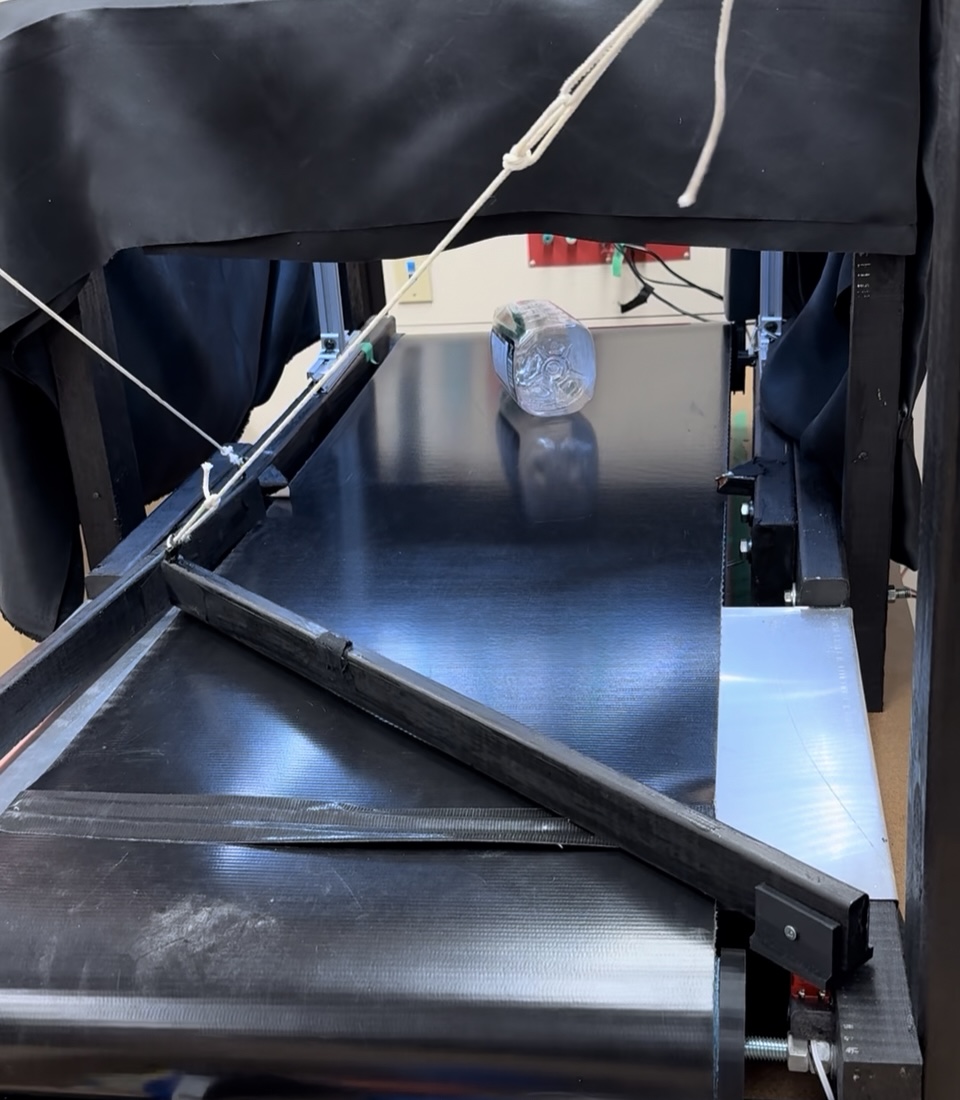
Automated Recycling Sorter
Motivation
With the increasing production of consumables and disposable items, efforts to improve waste management systems have become an increasingly popular topic for governments around the world. Many municipalities have adopted sustainable recycling methods that facilitate the recycling process for citizens and support more environmentally conscience practices. However, these changes can lead to a higher rate of inaccurate sorting of recycling which ultimately causes a significant portion of recyclable items to be incorrectly distributed to landfills. As a result, this project aims to improve this efficiency by developing a proof-of-concept automated recycling sorter that accurately sorts recycling into various bins. The proof-of-concept utilized mechanical components to orchestrate the transportation and distribution of the recycling items. Furthermore, a computer vision program was implemented to sort and distinguish the individual items. Ultimately, this will reduce waste sent to landfills while also prevent pollution, conserve energy, and protect natural resources.
Approach
The project was multifaceted thus requiring a systematic approach to ensure all components were integrated successfully. The tasks were divided among team members and sorted into three main categories: mechanical, electrical, and computing. The mechanical aspect involved designing the sorting apparatus and conveyor belt system requiring percise calculations and engineering drawings. The electrical component involved ensuring proper wiring and power delivery to the motors, as well as integrating the computer vision system with the mechanical components. Finally, the computing portion involved designing a convolution neural network to predict the type of recycling item. Further details are included in the report.
View Report (PDF)